By Manav Lawania, founder of MEGA LAW & G.K. | Last updated: | 7 min read
Quick answer
How to read CLAT passages faster? Glance at the questions first, then read the passage once at a steady pace and note the main idea of each paragraph in a few words. Answer by going back to the right paragraph, never from memory. Practise this daily with a timer.
The honest version upfront
- Faster reading comes from fewer re-reads, not from rushing every line.
- Four of the five CLAT sections use passages, so one skill lifts most of your paper.
- Speed without accuracy is useless. If your marks fall when your time falls, slow down a little.
- Three weeks can fix your method. They cannot undo years of not reading.
If you want to know how to read CLAT passages faster, start here. Often the problem is not your eyes. You read the passage twice because you do not trust your first reading, and that second reading eats your marks.
After 17 years of teaching CLAT and AILET, I give my students one fixed method. I will show it step by step. I also sell a passages workbook through MEGA LAW Books, and I will tell you clearly where it fits and where you do not need it. CLAT is on 6 December 2026, so use this from today.
Why Do CLAT Passages Take So Long to Read?
Because the paper is built on them. CLAT UG 2027 has 120 questions in 2 hours, with 1 mark for a right answer and 0.25 marks deducted for a wrong one. English, Current Affairs, Legal Reasoning and Logical Reasoning all come with passages of about 450 words, as the official syllabus says. Only Quantitative Techniques uses shorter sets of numbers and facts.
| Section | Passage length | What you must do with it |
|---|---|---|
| English Language | About 450 words | Find the main points, make inferences, understand words in context |
| Current Affairs and GK | Up to 450 words | Pick out facts and events from the passage |
| Legal Reasoning | About 450 words | Find the rule and apply it to the facts. No prior law is needed |
| Logical Reasoning | About 450 words | Find the argument, its premises and its conclusion |
| Quantitative Techniques | Shorter sets of numbers and facts | Work with the numbers |
Now do the sum. 120 questions in 120 minutes is about 1 minute a question. Say a passage carries five questions (the number changes). Then the whole set gets about 5 minutes, and that includes the reading. Every wasted minute inside the passage hurts you.
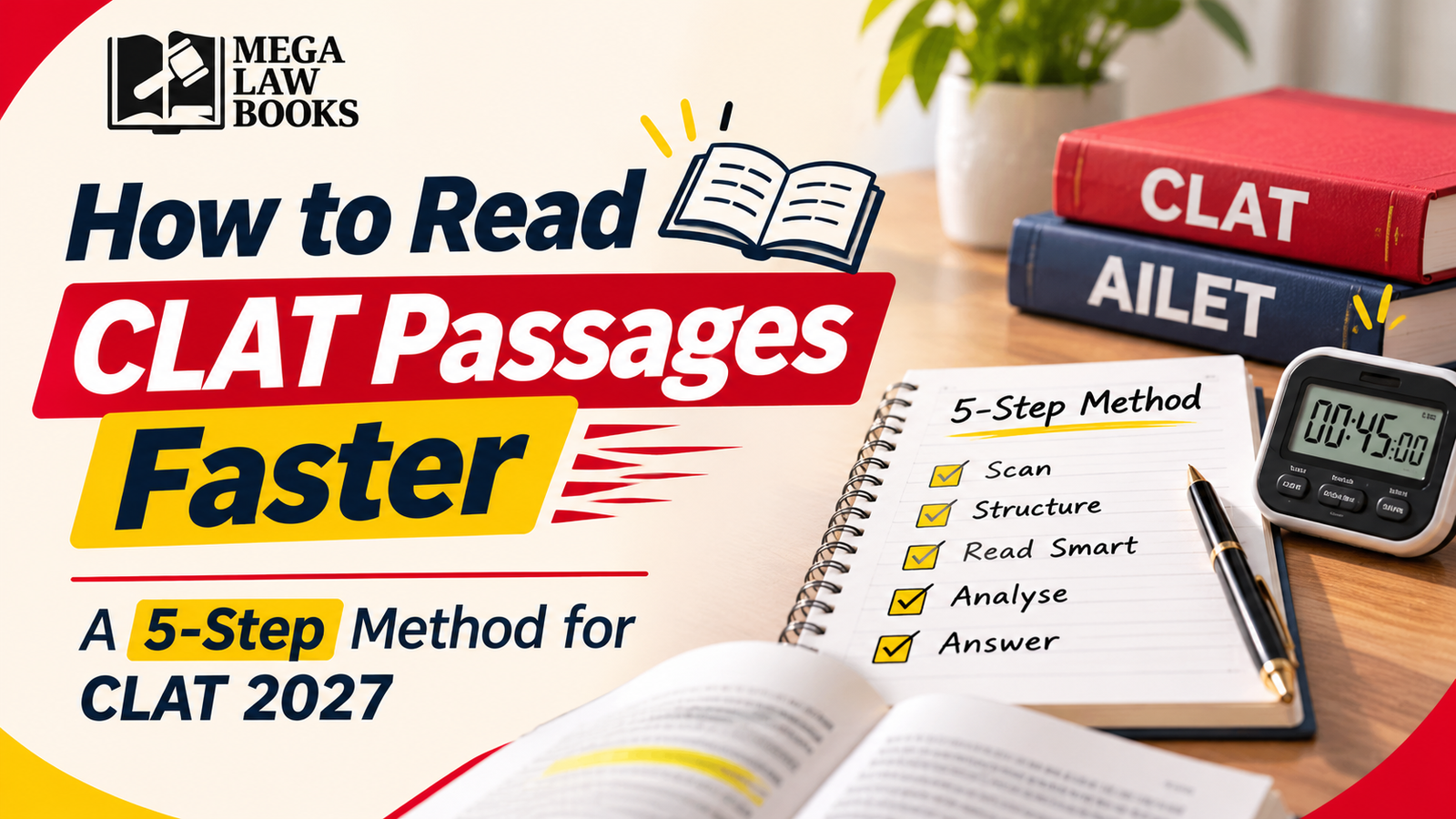
How to Read CLAT Passages Faster: The 5-Step Method
Follow this order on every passage.
- Glance at the questions first (20 seconds). Read only the question lines, not the options. Now you know what to look for, so your reading has a purpose.
- Read the passage once, at a steady pace. Do not stop for one hard word. Guess its meaning from the sentence and move on.
- Note the main idea of each paragraph in 3 or 4 words. In practice, write it in the margin. On the day, follow the exam’s rules on rough work. These notes are your map.
- Answer from the passage, not from memory. Go back to the right paragraph using your map. In Legal Reasoning, use only the rule the passage gives you. The official syllabus says no prior law is needed.
- Cut your losses. If a set is going badly, move on and come back if time is left. A wrong answer costs 0.25 marks, and a skipped question costs nothing.
| Step | Time |
|---|---|
| Glance at the questions | 20 seconds |
| Read once and note the ideas | 2 minutes |
| Answer the questions | 2 minutes 40 seconds |
| Total | 5 minutes |
450 words in 2 minutes is 225 words a minute. That is only a starting point. Time yourself on three passages, divide the words by your minutes, and build your own split. Do not copy mine blindly.
What I tell my students: accuracy first, then the clock
Start without a timer. Get your answers right with the method. Then bring the timer in. When your time drops and your marks stay the same, you are getting faster. When your marks fall, you went too fast. Go back one step.
How Do You Practise Reading Speed Every Day?
Tips do not make you fast. Practice does. Here is a 30-minute daily routine.
- 10 minutes: Solve 2 timed passages with the 5 steps. Start with the past papers on the official CLAT website.
- 10 minutes: Check every wrong answer. Find the exact line in the passage that proves the right option.
- 10 minutes: Write one line in an error log for each mistake: misread, rushed, used outside knowledge, or ran out of time.
- Once a week: Take one full section as a timed set.
With about three weeks left for 6 December 2026, run this every day and shift to full mocks in the last week. Our time management guide shows how to split your 120 minutes.
Which Mistakes Slow Down Your Reading?
| Mistake | Why it costs you | Fix |
|---|---|---|
| Reading the options before the passage | You hold four answers in your head while you read | Glance at the question lines only |
| Re-reading every sentence | It doubles your time and does not make you more accurate | Trust your margin notes |
| Stopping at every new word | It breaks your flow | Guess from the sentence and move on |
| Using what you already know | In Legal Reasoning the passage gives the rule, so outside ideas mislead you | Prove each option with a line from the passage |
| Spending 8 minutes on one set | It steals time from easier sets | Set a time cap and move on |
Want a teacher to guide your reading practice?
Explore MEGA LAW & G.K. Courses for CLAT and AILET 2027One honest note. You do not need any book to start the 5-step method today. Use past papers first. Buy a book only when you run out of good passages to practise on.
The problem, and the fix
Easy passages in practice. Hard passages in the paper.
Problem: You practise on easy passages, so your speed drops when the passage gets harder.
Fix: Practise on harder passages with a timer and read every explanation. Our CLAT Advanced Passages Mastery Workbook has 100 Level 3 and 4 passages, 100 timed quizzes and 100 explanations. It trains reading only. It does not replace Legal Reasoning or Quant practice.
Read once. Note the idea. Answer from the passage.Manav Lawania, Founder, MEGA LAW & G.K.
Not sure which step is your weak point? Send your question on WhatsApp.
Read next on MEGA LAW
Want the full list of books for every section? Read our guide Best Books for CLAT 2027, Section-wise. Weak in maths? Read our guide to the best books for CLAT quantitative techniques. Which English book should you buy? See the best books for CLAT English 2027.
Frequently asked questions
How can I read CLAT passages faster?
Use one fixed method on every passage: glance at the question lines, read once at a steady pace, note each paragraph’s main idea, and answer from the passage. Speed comes from fewer re-reads, not from rushing. Practise two timed passages every day and review every mistake.
How long should I spend on one CLAT passage?
CLAT UG 2027 has 120 questions in 2 hours, which is about 1 minute a question. If a passage has five questions, aim for about 5 minutes for the whole set, with about 2 minutes of that for reading. Treat this as a starting point and adjust it after you time yourself.
Should I read the questions before the passage?
Glance at the question lines for about 20 seconds, but do not read the options yet. This tells you what to look for while you read. If it confuses you in practice, read the passage first and see which way gives you better marks.
Is skimming enough for CLAT passages?
Skimming alone is risky, because one small word can change the answer in Legal Reasoning and Logical Reasoning. Read once at a steady pace and use your paragraph notes to find things again. Skim only to locate a line, not to understand it.
How many passages should I practise every day?
Two timed passages a day is a good base, followed by a careful review of every wrong answer. The review matters more than the count. Add more passages only if you can still review each one properly.
Can I improve my reading speed in three weeks?
You can improve your method and your timing in three weeks if you practise every day. You cannot build the reading habit of years in that time, so keep your goal realistic. Start today and do not skip days.
Which passages should I practise on?
Start with the past papers on the official CLAT website, because they show the real style. Then move to harder passages with timed quizzes and explanations, so that the paper feels easier. Read the explanation for every wrong answer.
Last updated: . We update this guide when exam facts change.